Berkas:PIA22094-TRAPPIST-1-PlanetLineup-20180205.jpg


Ringkasan
| Deskripsi |
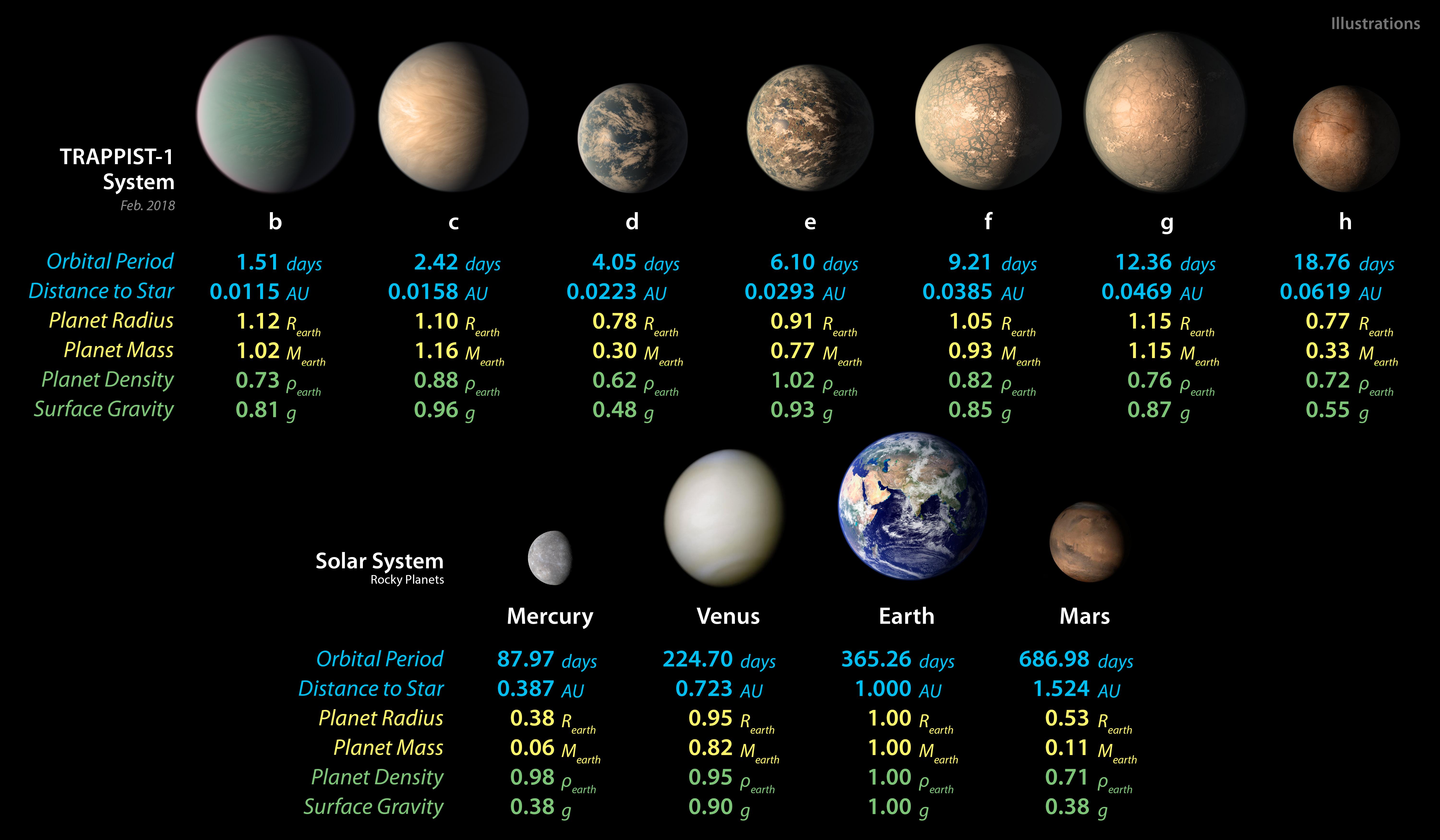
English: PIA22094: TRAPPIST-1 Planet Lineup - Updated Feb. 2018
https://photojournal.jpl.nasa.gov/catalog/PIA22094 This chart shows, on the top row, artist concepts of the seven planets of TRAPPIST-1 with their orbital periods, distances from their star, radii, masses, densities and surface gravity as compared to those of Earth. These numbers are current as of February 2018. On the bottom row, the same numbers are displayed for the bodies of our inner solar system: Mercury, Venus, Earth and Mars. The TRAPPIST-1 planets orbit their star extremely closely, with periods ranging from 1.5 to only about 20 days. This is much shorter than the period of Mercury, which orbits our sun in about 88 days. This image is an update to PIA21425. The masses and densities of the TRAPPIST-1 planets were determined by careful measurements of slight variations in the timings of their orbits using extensive observations made by NASA's Spitzer and Kepler space telescopes, in combination with data from Hubble and a number of ground-based telescopes. These measurements are the most precise to date for any system of exoplanets. In this illustration, the relative sizes of the planets are all shown to scale. NASA's Jet Propulsion Laboratory, Pasadena, California, manages the Spitzer Space Telescope mission for NASA's Science Mission Directorate, Washington. Science operations are conducted at the Spitzer Science Center at Caltech, also in Pasadena. Spacecraft operations are based at Lockheed Martin Space Systems Company, Littleton, Colorado. Data are archived at the Infrared Science Archive housed at Caltech/IPAC. Caltech manages JPL for NASA. For additional information about the Spitzer mission, visit http://www.nasa.gov/spitzer and http://spitzer.caltech.edu. For additional information on the Kepler and the K2 mission, visit www.nasa.gov/Kepler. For additional information about exoplanets, visit https://exoplanets.nasa.gov/. |
| Tanggal | |
| Sumber | https://photojournal.jpl.nasa.gov/jpeg/PIA22094.jpg |
| Pembuat | NASA/JPL-Caltech |
Lisensi

|
Pemegang hak cipta berkas ini, NASA/JPL-Caltech, mengizinkan orang lain untuk menggunakannya untuk tujuan apa pun, dengan syarat pemegang hak cipta disebutkan. Distribusi ulang, karya turunan, penggunaan komersial, dan penggunaan lain diizinkan. |
|
|
 
|
According to JPL's image use policy additional restriction is that no endorsement of any product or service by Caltech, JPL or NASA is claimed or implied.
Caltech's disclaimer: Caltech makes no representations or warranties with respect to ownership of copyrights in the images, and does not represent others who may claim to be authors or owners of copyright of any of the images, and makes no warranties as to the quality of the images. Caltech shall not be responsible for any loss or expenses resulting from the use of the images, and you release and hold Caltech harmless from all liability arising from such use. Usage on the English Wikipedia: On the English Wikipedia you can use the {{JPL Image}} template to display the copyright notice. (See w:Wikipedia:Using JPL images for details) |
Riwayat berkas
Klik pada tanggal/waktu untuk melihat berkas ini pada saat tersebut.
| Tanggal/Waktu | Miniatur | Dimensi | Pengguna | Komentar | |
|---|---|---|---|---|---|
| terkini | 6 Februari 2018 16.11 | Miniatur tidak tersedia | 6.000 × 3.500 (1,08 MB) | wikimediacommons>Drbogdan | User created page with UploadWizard |
Penggunaan berkas
Halaman berikut menggunakan berkas ini:
