Berkas:NH-07-10-15-Pluto-FirstGeology-20150709.jpg
Ringkasan
| Deskripsi |
English: July 10, 2015
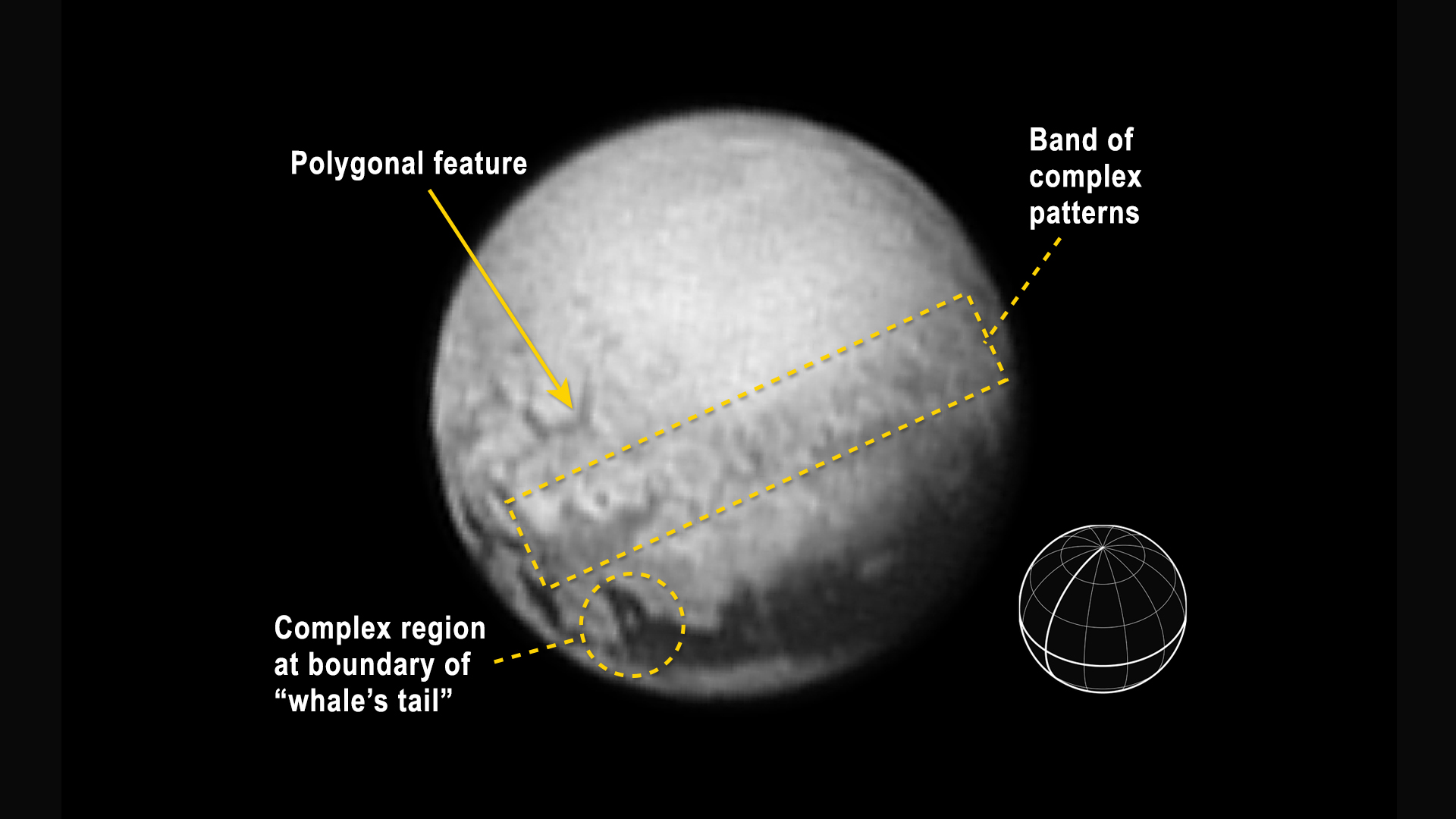
http://www.nasa.gov/feature/new-image-of-pluto-houston-we-have-geology New Image of Pluto: 'Houston, We Have Geology' Pluto Tantalizing signs of geology on Pluto are revealed in this image from New Horizons taken on July 9, 2015 from 3.3 million miles (5.4 million kilometers) away. Pluto An annotated version indicates features described in the text, and includes a reference globe showing Pluto’s orientation in the image, with the equator and central meridian in bold.
It began as a point of light. Then, it evolved into a fuzzy orb. Now – in its latest portrait from NASA’s New Horizons spacecraft – Pluto is being revealed as an intriguing new world with distinct surface features, including an immense dark band known as the “whale.” As the newest black and white image from New Horizons’ Long Range Reconnaissance Imager (LORRI) appeared on the morning of July 10, members of the science team reacted with joy and delight, seeing Pluto as never before. There will no doubt be many similar moments to come. New images and data are being gathered each day as New Horizons speeds closer to a July 14 flyby of Pluto, following a journey of three billion miles. “We’re close enough now that we’re just starting to see Pluto’s geology,” said New Horizons program scientist Curt Niebur, NASA Headquarters in Washington, who’s keenly interested in the gray area just above the whale’s “tail” feature. “It’s a unique transition region with a lot of dynamic processes interacting, which makes it of particular scientific interest.” New Horizons’ latest image of Pluto was taken on July 9, 2015 from 3.3 million miles (5.4 million kilometers) away, with a resolution of 17 miles (27 kilometers) per pixel. At this range, Pluto is beginning to reveal the first signs of discrete geologic features. This image views the side of Pluto that always faces its largest moon, Charon, and includes the so-called “tail” of the dark whale-shaped feature along its equator. (The immense, bright feature shaped like a heart had rotated from view when this image was captured.) “Among the structures tentatively identified in this new image are what appear to be polygonal features; a complex band of terrain stretching east-northeast across the planet, approximately 1,000 miles long; and a complex region where bright terrains meet the dark terrains of the whale,” said New Horizons principal investigator Alan Stern. “After nine and a half years in flight, Pluto is well worth the wait.” Follow the New Horizons mission with #PlutoFlyby and on Facebook at: https://www.facebook.com/new.horizons1 |
| Tanggal | |
| Sumber | http://www.nasa.gov/feature/new-image-of-pluto-houston-we-have-geology |
| Pembuat | NASA |
| Versi lainnya |
|


Lisensi

|
Berkas ini berada dalam domain publik di Amerika Serikat karena semata-mata diciptakan oleh NASA. Kebijakan hak cipta NASA menyatakan bahwa "materi NASA tidak dilindungi oleh hak cipta kecuali dicatat". (Lihat Template:PD-USGov, Halaman kebijakan hak cipta NASA atau JPL Image Use Policy.) |  |
 |
Peringatan:
|

Riwayat berkas
Klik pada tanggal/waktu untuk melihat berkas ini pada saat tersebut.
| Tanggal/Waktu | Miniatur | Dimensi | Pengguna | Komentar | |
|---|---|---|---|---|---|
| terkini | 11 Juli 2015 00.53 | | 1.920 × 1.080 (386 KB) | wikimediacommons>Drbogdan | User created page with UploadWizard |
Penggunaan berkas
Halaman berikut menggunakan berkas ini:
